Join a European System Blueprint
with Economic Credibility
Add a Title
Tusknet Business model
Tusknet is built on a simple but proven insight: awareness creates measurable economic value.
A concrete example is Airparif, the independent air-quality authority for the Île-de-France region. https://www.airparif.fr/actualite/2025/pollution-de-lair-en-ile-de-france-un-impact-economique-majeur-mais-des-actions
Airparif demonstrated that systemic awareness can generate substantial economic returns:
-
€5 billion investment
-
€61 billion benefit
-
ROI ≈ 1:10
Clean air, once treated as an externality, became a measurable economic asset. Awareness translated into long-term savings, health, productivity, and resilience.
Tusknet transfers this logic to society itself.
People read, grow, and co-create within Tusknet. Responsible and mature individuals learn to direct their energy, attention, and participation.
The question Tusknet asks is simple: What happens when societies do the same?
From this starting point, a systemic economic structure emerges: The core business statement is: “As Airparif created economic value from clean air, Tusknet creates economic strength from awareness.”
A classical financial logic becomes a systemic one, built on relationship, responsibility, and return.
Profit Centers
Tusknet is built around five interconnected profit centers. They generate value in different ways and reinforce each other through feedback loops rather than extraction.
-
tusknet.eu
The entry layer of the system. (Activates 1st March 2026)
Contributions of 20 / 60 / 100 euros activate participation and signal demand. -
tusknet.eu develops into Tusknet FI
The social media and awareness platform.
It generates value through time, attention, resonance, and relationship, replacing extractive advertising models with distributed, visible value creation. -
Tusknet Fund
The capital aggregation and allocation layer. Collective contributions and returns are translated into visible, regional investments and long-term stability. Visible regional investments and long-term stability (Return on Inclusion) -
Tusknet Pay
The transaction engine. Circular financial transaction flows that convert fees into regional infrastructure
Fees circulate back into regions, transforming payments into continuous funding for infrastructure, care, and education. -
Tusknet Energy
The physical infrastructure layer.
Renewable energy provides power, heat, and self-sufficiency for regions, data centers, and the digital system.
Together, these five profit centers form a closed-loop system in which money, energy, data, and attention remain connected to people and regions. Value is created, circulated, and reinvested within Europe.
Tusknet operates as a recursive system rather than a linear value chain.
The New System
Together, these profit centers describe the structure. What follows describes the dynamic that holds them together. Each generates outputs that feed back into the conditions of the others.
Contribution creates participation, participation generates resonance, resonance becomes value, and value returns as structure through regional investment, infrastructure, and stability.
These structures, in turn, deepen trust, increase participation, and renew contribution.
Growth therefore emerges through iteration and feedback, not through extraction or scale alone. The system learns and stabilizes itself over time, allowing economic value, social cohesion, and ecological responsibility to reinforce one another continuously.
Tusknet is the world’s first Human Systems Fund
Investing in people, culture and the future we create together.
Transition
From the inner architecture of Tusknet: its organization, business model, profit centers, and the recursive dynamics that connect them, the movement turns outward.
Tusknet enters Europe’s space of possibility. Forty countries, carried by their regions, appear not as competitors but as travelers. Each region brings its history, its wounds, its capabilities, and its images of the future.
Like people carrying backpacks on a shared journey, they bring difference, experience, and potential into a common field.
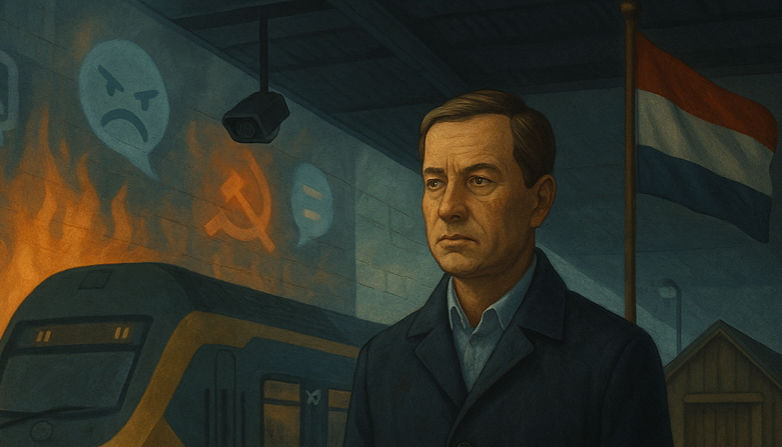
Within this space, Europe is digitally reassembled not through uniformity but through connection. The railway, as it appears in Katzenstein’s thinking, serves as an image of infrastructure that enables movement without prescribing destination or direction. It connects places without merging them. It creates proximity without dissolving difference.
Tusknet acts here as a quiet carrier. It offers no central identity, but a shared space of resonance. From forty national perspectives, a digital Europe begins to emerge that can think, feel, and learn precisely because it holds its diversity.
What follows is not another blueprint, but the description of a path: how regions, people, and systems begin to move together.